You can use a simple formula to sum numbers in a range (a group of cells), but the SUM function is easier to use when you’re working with more than a few numbers.
You use the SUMIF function to sum the values in a range that meet criteria that you specify. For example, suppose that in a column that contains numbers, you want to sum only the values that are larger than 5.
Select a cell next to the numbers you want to sum, select AutoSum on the Home tab, press Enter, and you're done. When you select AutoSum, Excel automatically enters a formula (that uses the SUM function) to sum the numbers.
You can use a simple formula to sum numbers in a range (a group of cells), but the SUM function is easier to use when you’re working with more than a few numbers.
In the Formula box, check the text between the parentheses to make sure Word includes the cells you want to sum, and click OK. Tip: If you change any of the numbers you're adding, select the sum and press F9 to update the total. You can use more than one formula in a table.
The SUMIFS function, one of the math and trig functions, adds all of its arguments that meet multiple criteria. For example, you would use SUMIFS to sum the number of retailers in the country who (1) reside in a single zip code and (2) whose profits exceed a specific dollar value.
Select a cell next to the numbers you want to sum, select AutoSum on the Home tab, press Enter, and you're done. When you select AutoSum, Excel automatically enters a formula (that uses the SUM function) to sum the numbers.
To quickly obtain the sum of a range of cells, select the range and see the sum displayed in the lower right-hand side of the Excel window. The Status Bar displays information regarding whatever is currently selected, whether a single cell or multiple cells.
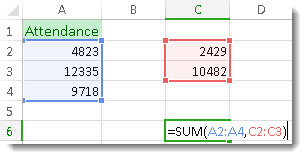 You can use a simple formula to sum numbers in a range (a group of cells), but the SUM function is easier to use when you’re working with more than a few numbers.